




Phoenix Real Estate Market 2027: The Next Great Buying Opportunity May Already Be Here
Why falling demand, rising seller concessions, and improving affordability could create one of the most interesting acquisition windows in years.
By Joe O’Brien | Phoenix Real Estate Investor, Realtor, Owner-Operator & Founder of Landlord in a Box™
The Phoenix housing market isn’t crashing. Buyers have simply stopped showing up.
And that distinction could make some investors a significant amount of money over the next several years.
I recently attended the November 9 AZREIA Greater Phoenix real estate market update, where we examined inventory, mortgage rates, buyer demand, contract activity, seller concessions, and the outlook for 2027.
One statistic stood out to me above everything else:
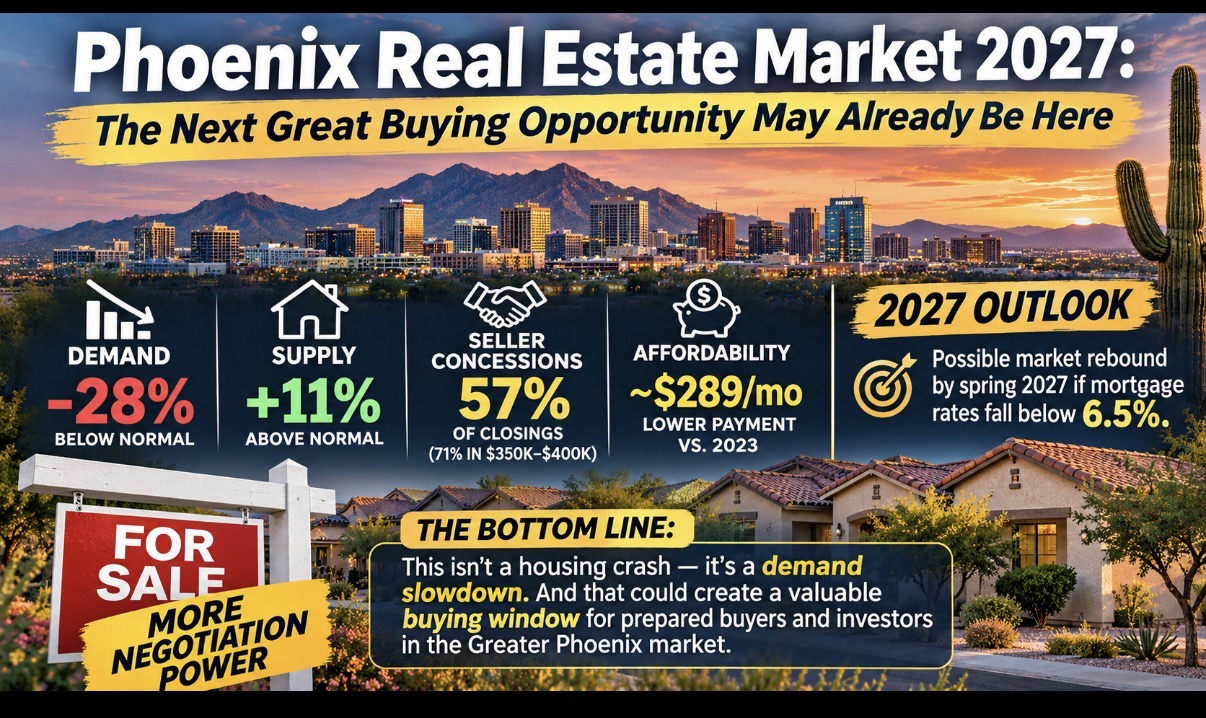
Phoenix housing demand is nearly 28% below normal, while supply is only 11% above normal.
Think about that.
We don’t have a massive oversupply of homes.
We have a shortage of motivated buyers.
And when buyers disappear, negotiating power shifts.
As a Phoenix Realtor for more than two decades, an investor with approximately 30 rental doors, and an operator involved in managing another 150 properties, I’ve learned something about real estate cycles:
The best opportunities rarely arrive when everyone feels confident. They arrive when everyone else is uncomfortable.
1. Phoenix Is in a Buyer’s Market — But Not for the Reason You Think
According to the November AZREIA market presentation, drawing on Cromford Report data, the Greater Phoenix market had the following indicators:
Cromford Market Index: 64.6
Demand Index: 72.1, approximately 28% below normal
Supply Index: 111, approximately 11% above normal
Active and coming-soon listings: 25,575 as of November 7, 2026
Inventory increase: 9.8% year over year
A Cromford Market Index below 90 generally indicates conditions favoring buyers.
But here’s the critical distinction.
During the Great Recession, Greater Phoenix experienced approximately 58,000 active listings.
Today, we’re below 26,000 using the presentation’s inventory measure.
During the 2007 collapse, the Cromford Market Index fell to approximately 21.
Today, it’s around 65.
Those are dramatically different market conditions.
This is not 2008.
We have elevated mortgage rates, affordability challenges, and hesitant buyers.
But we do not currently have the same combination of extreme inventory, distressed lending, and foreclosure pressure that characterized the last housing collapse.
And that creates a different type of opportunity.
2. The Biggest Story Nobody Is Talking About: Sellers Are Negotiating
Here’s where the market gets interesting.
According to the presentation:
57% of Greater Phoenix MLS closings include seller-paid concessions.
In the $350,000–$400,000 price range, that number jumps to approximately 71%.
Let that sink in.
In that price segment, roughly seven out of ten closed transactions involve seller concessions.
Those concessions can potentially be used toward closing costs or mortgage-rate buydowns, subject to financing rules and negotiated terms.
Meanwhile, the average sale-to-list price is approximately 97%.
This is a completely different environment from the bidding wars of 2021 and early 2022.
Buyers can negotiate.
Investors can request repairs.
And sellers who need certainty may be more receptive to creative financing structures.
But I want to emphasize something.
A seller concession doesn’t automatically make a bad deal a good deal.
You still have to understand the property’s value, financing costs, repairs, rental demand, and exit strategy.
Negotiating a $15,000 concession on a property that’s overpriced by $40,000 isn’t winning.
It’s simply losing less.
3. The $500,000–$800,000 Market Is Sending a Warning Signal
One of the most revealing statistics from the AZREIA update involved pending transactions.
Year-over-year escrow activity declined approximately:
28.4% in the $500,000–$599,999 segment.
29.8% in the $600,000–$799,999 segment.
These are substantial declines in buyer activity.
Why?
Because this segment is particularly sensitive to monthly mortgage payments.
Many buyers can qualify for the purchase price, but they aren’t comfortable with the payment.
And I believe this creates opportunities for buyers who understand how to negotiate the entire transaction, not just the purchase price.
Consider a hypothetical $750,000 Scottsdale property.
Would you rather receive a $15,000 price reduction or a $15,000 seller credit?
Depending on the loan structure, interest rate, and how long you plan to own the home, the seller credit could provide more immediate payment relief.
Smart buyers don’t just negotiate price. They negotiate affordability.
That’s an important distinction in today’s market.
4. Phoenix Housing Affordability Has Quietly Improved
Here’s another statistic that surprised some people.
Despite the negative headlines, affordability has improved compared with late 2023.
The AZREIA presentation compared a representative single-family home purchase:
October 2023
Median price: $423,000
Mortgage rate: 7.79%
Estimated monthly payment: $2,857
November 2026
Median price: $400,000
Mortgage rate: 7.18%
Estimated monthly payment: $2,568
That’s approximately $289 per month in savings, or nearly $3,500 annually.
These are illustrative estimates using the presentation’s financing assumptions, including 20% down and estimated taxes and insurance.
Now, does that mean Phoenix housing is suddenly affordable for everyone?
Absolutely not.
But affordability is moving in a more favorable direction than it was three years ago.
And there’s another variable that could change the equation.
Mortgage rates.
5. Why 6.5% Could Be the Number That Changes Everything in 2027
I believe mortgage rates are one of the most important variables to watch over the next six months.
The presentation identified 6.5% as a potential psychological threshold for buyers.
If mortgage rates move sustainably below that level, particularly toward 6%, we could see some sidelined buyers return.
Not because home prices suddenly become cheap.
But because the monthly payment begins to make sense again.
And here’s the paradox.
The very thing buyers are waiting for could eliminate some of their negotiating power.
Lower rates could bring additional competition.
Additional competition could reduce seller concessions.
And reduced concessions could offset some of the savings buyers expected from lower mortgage rates.
This is why I believe the period between now and spring 2027 deserves serious attention.
That doesn’t mean rates are guaranteed to fall or prices are guaranteed to rise.
They aren’t.
But investors should be preparing for multiple scenarios rather than waiting for a perfect market that may never arrive.
6. Not All Phoenix Markets Are Created Equal
This is where national real estate headlines become particularly misleading.
Phoenix is not one market.
Scottsdale is not Buckeye.
Paradise Valley is not Maricopa.
And Tempe’s rental dynamics are not identical to those in Surprise.
The November presentation highlighted meaningful geographic differences.
Outer-ring markets, including Buckeye, Maricopa, Goodyear, and Surprise, have generally experienced greater buyer-market pressure.
These locations may provide opportunities for buyers seeking larger discounts or more favorable terms.
Core and established markets, including Scottsdale, Paradise Valley, and Chandler, have demonstrated greater resilience according to the market indicators discussed.
That doesn’t mean every home in those cities is a great investment.
It means market selection matters.
As an investor, I care less about what the national housing market is doing and more about what’s happening within a few miles of the property I’m evaluating.
What is the actual rental demand?
How much competing inventory exists?
What concessions are sellers offering?
How long are properties sitting on the market?
What is the realistic cost of ownership?
Real estate is national in the headlines, local in the numbers, and hyperlocal in the profits.
7. My Bigger Thesis: We’re Moving Toward a Renter Society
This is where my perspective as an owner-operator differs from that of someone who only studies home sales.
I believe we’re experiencing a structural shift in American housing.
More households want the lifestyle associated with owning a single-family home without necessarily taking on the cost or responsibility of ownership.
They still want:
A backyard.
A driveway.
Privacy.
Room for children and pets.
A neighborhood where they can establish roots.
They just may not want, or be financially prepared for, a 30-year mortgage at today’s payment levels.
I call this The Renter Society™.
And I believe it creates an enormous long-term opportunity for disciplined single-family rental investors.
But here’s the part many investors overlook.
Buying the rental property is only half the business. Operating it successfully is where long-term wealth gets built.
Tenant selection, maintenance, customer service, retention, rent collection, vacancy control, and operating expenses all matter.
That’s one of the reasons I developed Landlord in a Box™ — an operating framework built around acquiring, improving, leasing, and managing rental properties as sustainable businesses.
The next generation of successful landlords won’t necessarily be the investors who own the most houses.
They may be the investors who operate their properties the best.
8. My 2027 Phoenix Real Estate Forecast
Based on the market data, my experience operating rental properties, and the opportunities I’m currently evaluating, here’s my working thesis.
First: I expect buyers to retain meaningful negotiating leverage into early 2027, particularly in rate-sensitive price segments and outer-ring markets, assuming demand remains subdued.
Second: I expect well-priced, desirable homes in established neighborhoods to outperform poorly positioned properties. The market will continue rewarding quality, location, and realistic pricing.
Third: I believe rental investors should be aggressively analyzing opportunities, not blindly purchasing them. Condos, single-family homes, and small multifamily properties may offer attractive entry points when the numbers support the investment.
Fourth: I believe seller financing and other creative acquisition structures could become increasingly valuable. When conventional financing creates friction, solving the seller’s problem can sometimes create opportunities that a simple cash offer cannot.
Finally: If mortgage rates decline enough to stimulate demand in spring 2027, some of today’s negotiating advantages could begin to disappear.
That is a forecast, not a guarantee.
The key is preparation.
The Bottom Line: Don’t Confuse a Slow Market With a Bad Market
In May 2011, the Greater Phoenix median sale price was approximately $108,100.
At the time, many people believed housing had further to fall.
Today, the broader market’s median pricing is several times higher.
That doesn’t mean every property purchased in 2011 was a winner.
It means market psychology can look very different from long-term investment outcomes.
And I think there’s an important lesson for 2027.
You don’t build wealth by simply buying when everyone else is buying.
You build wealth by understanding value, managing risk, negotiating intelligently, and holding quality assets through market cycles.
The next great Phoenix real estate opportunity probably won’t arrive with a headline announcing that it’s time to buy.
It may already be sitting on the MLS, overpriced, overlooked, and waiting for someone who understands the numbers.
That’s the market I’m studying.
And that’s where I’m looking for opportunity.
About Joe O’Brien
Joe O’Brien is a Phoenix-based Realtor, real estate investor, owner-operator, and founder of Landlord in a Box™. With more than two decades of real estate experience, approximately 30 rental doors owned, and another 150 properties under management, Joe works with buyers, sellers, landlords, and investors throughout Greater Phoenix.
His focus includes single-family rental acquisitions, creative financing, property management, and building long-term wealth through disciplined real estate ownership.
What’s your prediction for the Phoenix housing market in 2027?
Will lower mortgage rates bring buyers back, or will affordability continue to keep demand on the sidelines?
I’d love to hear what other Phoenix investors, agents, and property owners are seeing.
Market statistics referenced from the November 9, 2026 AZREIA Greater Phoenix market update, including Cromford Report indicators and MLS market data. Figures are presentation estimates and may vary by methodology, property type, and reporting date.
#PhoenixRealEstate #PhoenixHousingMarket #ArizonaRealEstate #RealEstateInvesting #PhoenixRealtor #PropertyManagement #RentalPropertyInvesting #CreativeFinancing #LandlordInABox #RealEstateMarket2027